
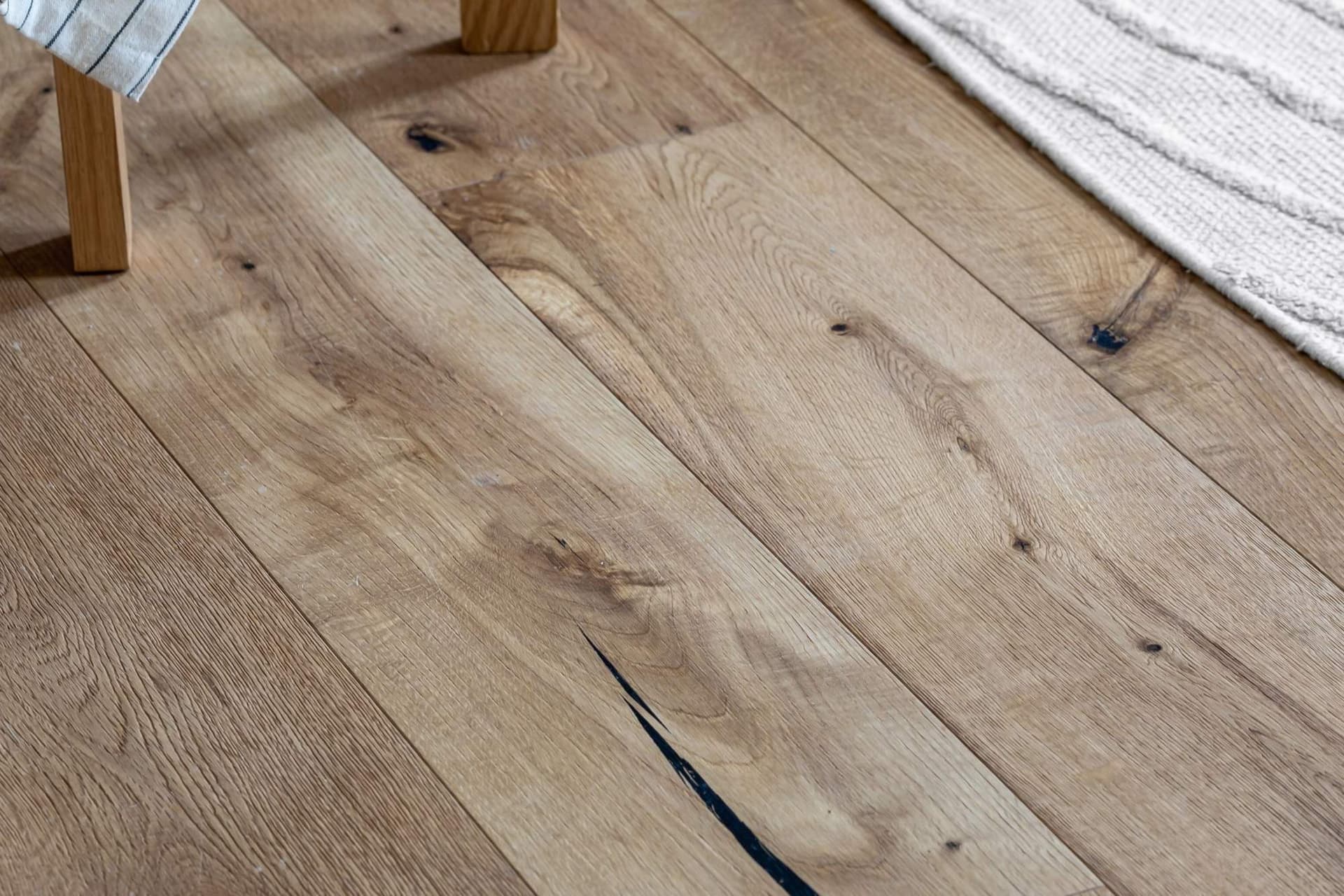
Florida humidity matters for wood floors, and Mohawk's laminate and luxury vinyl come with humidity limits too. Mohawk's instructions call for installing within those limits, and for its RevWood and TecWood floors, keeping the home within them for the life of the floor.
Mr. Wright Flooring is a family-owned flooring company in Jacksonville, in business since 2012 and a member of the National Wood Flooring Association (NWFA). This post is part of our guide to the best flooring for a Florida home. Below, we cover what local humidity looks like, how wood responds to it, the indoor ranges experts give, acclimation, and what to do when the house is closed up.
What Jacksonville humidity looks like
NOAA's Jacksonville records show how much the humidity swings in a single day. In NOAA's comparative climate data for the Jacksonville station, covering 1948 to 2018, the average morning relative humidity runs between 85% and 92% in every month. The afternoon average runs between 48% and 63%. NOAA takes the morning reading at 7 a.m. and the afternoon reading at 1 p.m., local standard time.
The highest morning averages come in August (91%), September (92%) and October (91%). April has the lowest afternoon average, at 48%. Relative humidity, the measure behind all of these numbers, compares the water vapor in the air with the most the air can hold at that temperature, as the Florida Climate Center at Florida State University explains it.
The Florida Climate Center's 2014 humidity explainer describes the same daily pattern statewide. On a typical summer day, relative humidity rises above 90% at night and falls to 60% or less in the afternoon heat. The explainer calls Florida the most humid state in the U.S. These are outdoor numbers, and a wood floor responds mainly to the air inside the house.
How wood floors respond to humidity
Wood trades moisture with the air around it. The USDA Forest Products Laboratory's Wood Handbook calls wood hygroscopic, meaning it takes on moisture from its surroundings. Over time, wood settles at its equilibrium moisture content, the point where it is neither gaining nor losing moisture.
The handbook's tables show how far that point moves. At 70°F, wood comes to about 9.2% moisture content in air at 50% relative humidity, 12.0% at 65%, 16.0% at 80% and 20.5% at 90%. The handbook says more humid air causes slight swelling and drier air causes slight shrinkage, and that this movement can lead to problems such as gaps in flooring.
The handbook also says the moisture content of interior wood depends mainly on indoor relative humidity. Indoor humidity, in turn, depends on moisture sources, ventilation, dehumidification such as air conditioning, and outdoor humidity. Mohawk's TecWood instructions add that wood movement is smallest when indoor humidity is kept steady year-round.
If you are deciding between solid and engineered wood, our post on real hardwood in a Florida house goes deeper. You can also read about our hardwood flooring and engineered hardwood flooring.
Indoor humidity ranges differ by source
No single indoor humidity number fits every floor. NWFA, Mohawk and UF/IFAS Extension each publish their own range, and the ranges do not match. Here is what each one says.
- NWFA: As a general rule for solid wood, with geographic exceptions, the NWFA installation guidelines call for 30% to 50% relative humidity and 60 to 80°F. For factory-finished solid and engineered floors, NWFA says to follow the manufacturer's requirements.
- Mohawk TecWood Enhanced (engineered hardwood): 35% to 55% relative humidity and 65 to 75°F. Mohawk says permanent HVAC should run for at least five days before delivery, and those conditions should hold during and after installation for the life of the floor.
- Mohawk RevWood (laminate): climate-controlled indoor installations only, at 35% to 65% relative humidity and 60 to 85°F.
- Mohawk SolidTech (rigid luxury vinyl): humidity below 65%, at 55 to 85°F, for 48 hours before, during and after installation.
- UF/IFAS Extension: general advice for Florida homes, not a flooring specification, is to keep indoor relative humidity around 55% or lower.
For a factory-finished floor, NWFA says to follow the manufacturer's range. Mohawk's numbers change from line to line. If you are looking at one of the Mohawk floors we carry, ask which instructions apply to that product.
Key takeaway: Follow the humidity range written for your specific floor, because NWFA, Mohawk and UF/IFAS each give a different number.
Why Mohawk's LVP still has humidity limits
Mohawk's SolidTech warranty calls the floor 100% waterproof. That warranty refers to topical water, such as a spill on top of the floor. It does not cover moisture coming up from below the floor, flooding, or damage to the subfloor or adhesives.
Humidity still matters. Mohawk's SolidTech warranties apply only to indoor installations in dry, climate-controlled conditions. Its installation instructions say a fully operational HVAC system is the best way to control temperature and humidity. Mohawk also requires a 3/8-inch expansion space around the whole SolidTech installation so the floor can expand and contract.
Mohawk's RevWood laminate works the same way. Mohawk's RevWood instructions say acceptable humidity and subfloor moisture conditions must be maintained for the lifetime of the floor. Read more on our luxury vinyl plank flooring and laminate flooring pages.
Key takeaway: On Mohawk's SolidTech warranty, "waterproof" means water from above, and the floor still needs the climate control Mohawk asks for.
Acclimation: letting the floor adjust before it goes down
Acclimation means letting new flooring adjust to the home before it is installed. The Wood Handbook says to install wood at the moisture content it will have in service, which keeps later swelling and shrinking small and helps avoid problems such as floor buckling. The handbook also recommends checking random pieces with a moisture meter when the flooring arrives and again before installation.
Mohawk says all of its wood floors must acclimate for at least 72 hours, after the HVAC, windows and building envelope are complete and running. Its SolidTech vinyl calls for 48 hours in the room of installation at 55 to 85°F. For Mohawk's floors, the instructions set a moisture limit for concrete slabs, and the installer should confirm the slab meets it before installing.
Every project we install is supervised by an experienced team leader who keeps the install inside the manufacturer's warranty guidelines. Learn more about our professional installation.
Keeping a closed-up home's humidity under control
A second home, or a house left empty for the summer, still needs humidity control. UF/IFAS Extension notes that in Florida, air conditioners also remove moisture from the air. It says a properly sized, well-maintained HVAC system plays an important role in controlling indoor humidity. You can track the humidity with an inexpensive hygrometer or a thermostat with a built-in humidity sensor.
A 2005 Florida Solar Energy Center study looked at three vacant homes in Brevard County over the summer and fall. Its targets were relative humidity below 70% essentially all the time and below 65% most of the time. Setting the air conditioner at 85°F gave generally poor results, because the system ran too little to remove enough moisture. Letting the house float with no conditioning could not reliably keep humidity below 65% most of the time.
The study rated three approaches as effective. One was running the air conditioner at 74°F for early-morning hours on a programmable thermostat. The others were running a dehumidifier with a floor fan and running the central heating system. It was a study of three homes, so it is a useful guide rather than a rule for every house.
Mohawk's RevWood and TecWood warranties require a continuously climate-controlled home. Not every approach in the study fits Mohawk's conditions: the heating approach held the houses at 88°F to 90°F, above the temperature ranges in Mohawk's RevWood and TecWood Enhanced instructions. For coastal and waterfront homes, and other places with high humidity year-round, Mohawk's TecWood Enhanced instructions call for an air conditioner or dehumidifier to keep humidity in range. Our beach house flooring guide covers homes at the Jax Beaches and Ponte Vedra.
Key takeaway: In an empty house, keep humidity controlled instead of shutting the AC off: Mohawk's wood warranties require continuous climate control, and an 85°F setting removed too little moisture in the FSEC study.
Choosing a floor for a humid home
Humidity is part of choosing any floor in Jacksonville, whether you want hardwood, laminate or luxury vinyl. The useful questions are which humidity range the manufacturer sets for that floor, how long it needs to acclimate, and whether your home can hold that range year-round. Call (904) 443-9473 to set up a free in-home estimate, or book an appointment to browse the selections in our showroom.
Frequently asked questions
Does humidity ruin wood floors?
Humidity makes wood move, and too much movement causes problems. The USDA Wood Handbook says wood takes on moisture from the air, swells slightly in more humid air and shrinks in drier air, and that this movement can lead to problems such as gaps in flooring. Mohawk says wood movement is smallest when indoor humidity is kept steady year-round. Mohawk's TecWood Enhanced instructions also say its warranties do not cover damage caused by excessively low or high humidity. Keeping the home within the range in your floor's instructions is what Mohawk asks for its floors.
What humidity should I keep my house at for wood floors?
It depends on the floor and whose guidance you follow. NWFA's general rule for solid wood is 30% to 50% relative humidity, with geographic exceptions, and NWFA says factory-finished floors should follow the manufacturer's requirements. Mohawk's TecWood Enhanced engineered hardwood calls for 35% to 55%, and Mohawk's RevWood laminate for 35% to 65%. UF/IFAS Extension's general advice for Florida homes is around 55% or lower. Follow the range in the instructions for the floor you buy.
Does waterproof LVP have humidity limits?
Mohawk's SolidTech does. Its waterproof warranty covers topical water, such as spills, not moisture from below the floor or flooding. Mohawk's SolidTech instructions call for humidity below 65% for 48 hours before, during and after installation, and its SolidTech warranties apply only to indoor installations in dry, climate-controlled conditions. These are Mohawk's terms for SolidTech, so check the installation instructions for the product you choose.
Should I turn off the AC when I leave my Florida home for the summer?
If you have Mohawk RevWood or TecWood floors, Mohawk's warranties require a continuously climate-controlled home. In a 2005 Florida Solar Energy Center study of three vacant Brevard County homes, setting the AC to 85°F gave generally poor humidity control. Running the AC at 74°F for early-morning hours, using a dehumidifier with a floor fan, or running the central heat were the three approaches the study rated effective. The heating approach held the houses at 88°F to 90°F, though, which is above the temperature ranges in Mohawk's RevWood and TecWood Enhanced instructions.
How long should new flooring acclimate?
It depends on the product. Mohawk's TecWood Enhanced instructions say all Mohawk wood floors must acclimate for at least 72 hours, after the HVAC, windows and building envelope are complete and running. Mohawk SolidTech calls for 48 hours in the room of installation at 55 to 85°F. Mohawk RevWood needs no on-site acclimation if it is delivered at the home's normal living conditions and those conditions are kept; otherwise it acclimates for 48 hours. The USDA Wood Handbook also recommends checking random pieces with a moisture meter on arrival and before installation.
How do I check the humidity in my house?
UF/IFAS Extension says you can monitor indoor humidity with an inexpensive hygrometer or a thermostat with a built-in humidity sensor. Its general advice for Florida homes is to keep indoor relative humidity around 55% or lower. If you have a wood, laminate or vinyl floor, compare your readings with the range in that floor's installation instructions, since NWFA and Mohawk each set their own, and Mohawk's change from product to product.
Thinking about new floors?
The same crew, still family-owned. Free in-home estimate across Jacksonville and Northeast Florida.