
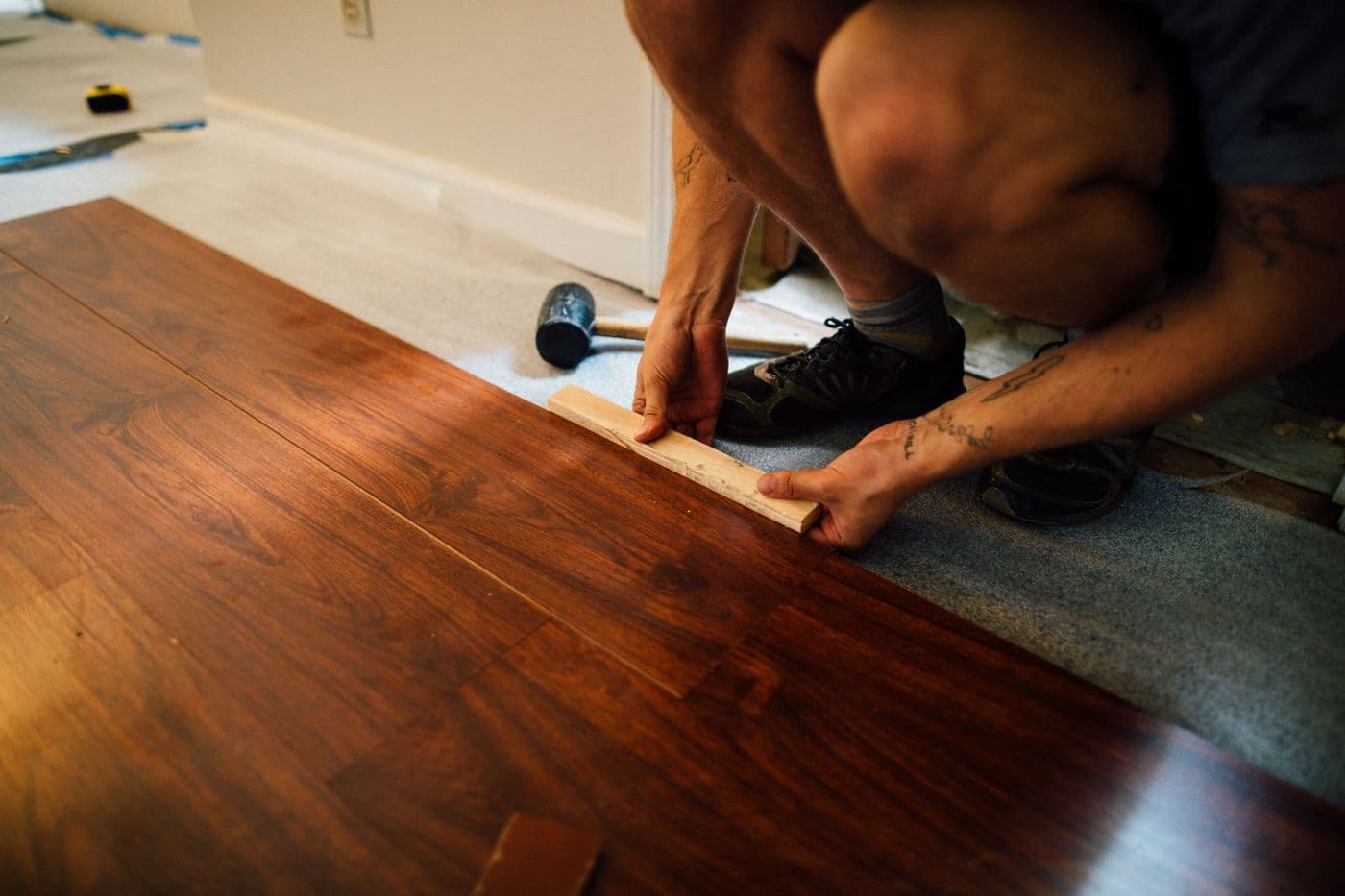
Over a concrete slab, the two methods this article covers are floating and glue-down. A floating floor rests on an underlayment and is not fastened to the slab, while a glue-down floor is bonded to the concrete with the adhesive the manufacturer approves. The National Wood Flooring Association's 2019 concrete subfloor fact sheet says to always follow the wood flooring and adhesive manufacturer's recommendations for application specifics, so the floor you choose decides the method. Nailing and stapling come up too, but the instructions cited here write them for wood subfloors and sleepers.
This article is part of our Florida flooring guide. Mr. Wright Flooring is a family owned and operated flooring retailer and installer in Jacksonville, and every project we do is supervised by an experienced team leader who keeps the install inside the manufacturer's warranty guidelines. Below, each rule is credited to the manufacturer or trade group that wrote it.
How a floating floor goes down over a slab
A floating floor is not glued, nailed or screwed to the concrete. Mohawk's RevWood installation guide says the floor installs as a floating floor and that its movement must not be constrained by glue, nails, screws, hardware or other fixed obstructions.
What goes under the planks matters. Mohawk's TecWood Essentials, Select and Plus instructions call underlayment requirements critical to a floating installation, and they name excessive pad compression as a common cause of seam failure.
Over concrete, the RevWood guide calls for a polyethylene vapor barrier or Performance Accessories MoistureBarrier first, with seams overlapped 8 inches or more. For RevWood planks without attached underlayment, the guide drops the polyethylene barrier if the separate underlayment has a fully attached moisture barrier. Mohawk's SolidTech installation instructions highly recommend a polyethylene vapor barrier of at least 6 mil for all floating installs, overlapped 8 inches and taped at the seams. They also say the barrier should not be used to solve a moisture problem, and that cupping or peaking claims without a proper vapor barrier could be denied.
Key takeaway: A floating floor still needs the underlayment and vapor barrier its own instructions call for.
How a glue-down floor goes down over a slab
A glue-down floor is bonded straight to the concrete with the adhesive system the flooring maker approves. Mohawk's TecWood Enhanced installation instructions say to spread the adhesive with the recommended trowel, ensuring 95% to 100% adhesive contact.
The slab has to qualify, too. Those instructions allow glue-down over concrete rated 3,000 psi or greater and say glue-down over lightweight concrete, under 3,000 psi, is not permissible. They also list a moisture-control adhesive rated for up to 99% relative humidity (RH) in concrete. When that moisture-control method is not used, they say moisture tests must be done on all concrete subfloors, regardless of grade level or age.
Glue-down is also the route for some solid wood. Mohawk's installation FAQ says its engineered and Longstrip hardwood can go over most concrete slabs but its solid hardwood cannot, except that its 3/8-inch solid products may be glued to a slab using Mohawk's approved glue and sealant system. The National Wood Flooring Association's 2019 concrete subfloor fact sheet says solid and engineered wood floors can both be installed over concrete that is properly prepared for the wood. Our article on real hardwood in a Florida house covers that choice in more depth.
Key takeaway: With glue-down, the slab's strength, the adhesive system and the moisture test all have to meet the manufacturer's rules.
Where nail-down and staple-down fit
In the instructions cited here, nail-down and staple-down are written around wood beneath the floor. Mohawk's TecWood Essentials, Select and Plus instructions cover staple-down installs over wood subfloors. The National Wood Flooring Association (NWFA) describes screeds, also called sleepers, as lumber boards laid over or embedded in a substrate to give wood flooring a nailing surface.
That build-up does not suit every product. Mohawk's SolidTech instructions say wood subfloors fastened directly to concrete, or sleeper construction, are not recommended under SolidTech. If you want a nailed floor over a slab, start with the instructions for that exact product.
Why the slab moisture test comes first
Every method above depends on the slab being dry enough. Mohawk's TecWood Enhanced instructions say excess moisture in any flooring substrate, if not found and corrected before installation, will cause floor covering failure. They add that Mohawk's warranties do not cover problems from moisture above its guidelines.
Mohawk names ASTM test methods in its instructions, and the limits change from line to line:
- SolidTech rigid vinyl: 8 lb or less per 1,000 sq ft per 24 hours by calcium chloride test (ASTM F1869), or under 90% RH by in-situ probe (ASTM F2170), with one more test for each additional 1,000 sq ft.
- TecWood Enhanced engineered hardwood: a slab cured at least 60 days, then 5 lb or less by ASTM F1869 or under 80% RH by ASTM F2170, with results recorded and left with the homeowner.
- RevWood laminated wood: Mohawk lists three tests: 4.0% moisture content or less with a meter calibrated for concrete (ASTM F2659); 5 lb or less by ASTM F1869; 80% RH or less by ASTM F2170. Results are recorded at the time of installation, and if any result is outside its limit, the floor should not be installed.
If a result is over the limit, Mohawk's TecWood instructions say not to install. To correct it, they say to wait until the subfloor dries to meet specifications or use an appropriate moisture barrier.
Mohawk's SolidTech instructions put the final responsibility for deciding whether the concrete is dry enough on the floor covering installer. Whoever installs your floor, whether that is our crew, your own crew or you, should confirm the slab meets the manufacturer's limit before the first plank goes down.
A Mohawk waterproof floor is not an exception. Mohawk's SolidTech warranty says its waterproof coverage refers to topical water, such as a spill on top of the floor, and does not cover moisture coming from below the product. The SolidTech instructions also say on- or below-grade slabs must have an effective vapor retarder directly under the slab.
Key takeaway: Mohawk's slab moisture limits differ between product lines, so a test result has to be read against the instructions for the floor going in.
Leave room for the floor to move
Each of the three Mohawk lines covered here calls for an expansion gap at the edges. The SolidTech instructions call for a 3/8-inch expansion space for the entire installation and say nails or screws must never enter the planks or the expansion zone around the perimeter. The RevWood guide asks for at least 3/8 inch between the floor and any obstruction. The TecWood Essentials, Select and Plus instructions set the gap equal to the plank thickness, around the room and around pipes, cabinets, doorframes and other fixed objects.
Long runs need a break as well. SolidTech calls for a transition strip in rooms with a run greater than 50 feet. RevWood calls for T-moldings in rooms 50 feet or larger in length or width and in doorways narrower than 32 inches.
Key takeaway: The right expansion gap comes from the product's instructions, and it is not the same across Mohawk lines.
Which method should you choose?
Start with the floor, then let its instructions set the method, the vapor barrier, the moisture limit and the gap. If you are still weighing materials, our comparison of engineered hardwood vs. LVP on a slab covers that decision.
We are an authorized Mohawk retailer. You can buy your floor from us and have our crew install it. You can have us install a floor you bought elsewhere through our Professional Installation service. Or you can buy from us and install it yourself or with your own crew.
To talk through the floor you have in mind and how it should go down over your slab, request a free estimate or call (904) 443-9473. Estimates and in-home measures are free.
Frequently asked questions
Can you glue engineered hardwood directly to concrete?
Mohawk's FAQ says its engineered hardwood can go over most concrete slabs that are cured at least 60 days, free of structural defects, clean and visually dry with no history of moisture problems. For glue-down, Mohawk's TecWood Enhanced instructions require concrete rated 3,000 psi or greater, with the adhesive spread for 95% to 100% contact. The exact rules depend on the product, so check its installation instructions.
Does a floating floor need a vapor barrier over concrete?
Mohawk's RevWood and SolidTech instructions both address it. The RevWood guide says to install a polyethylene vapor barrier or Performance Accessories MoistureBarrier over concrete first, with seams overlapped 8 inches or more. For RevWood planks without attached underlayment, the guide drops the polyethylene barrier if the separate underlayment has a fully attached moisture barrier. The SolidTech instructions highly recommend a polyethylene barrier of at least 6 mil for all floating installs. SolidTech's instructions add that the barrier should not be used to solve moisture problems; the moisture has to be dealt with by other means.
Can solid hardwood go over a concrete slab?
It depends on the manufacturer. NWFA says solid and engineered wood floors can be installed over concrete subfloors when the concrete is properly prepared for the wood. Mohawk's FAQ says its own solid hardwood is not for concrete slabs, except its 3/8-inch solid products, which may be glued to a slab with Mohawk's approved glue and sealant system.
If my floor is waterproof, does the slab still need testing?
For Mohawk SolidTech, yes. Mohawk's SolidTech warranty limits waterproof coverage to topical water and does not cover moisture coming from below the product. SolidTech's instructions still set slab limits of 8 lb or less per 1,000 sq ft per 24 hours by calcium chloride test (ASTM F1869), or under 90% RH by in-situ probe (ASTM F2170).
Thinking about new floors?
The same crew, still family-owned. Free in-home estimate across Jacksonville and Northeast Florida.