
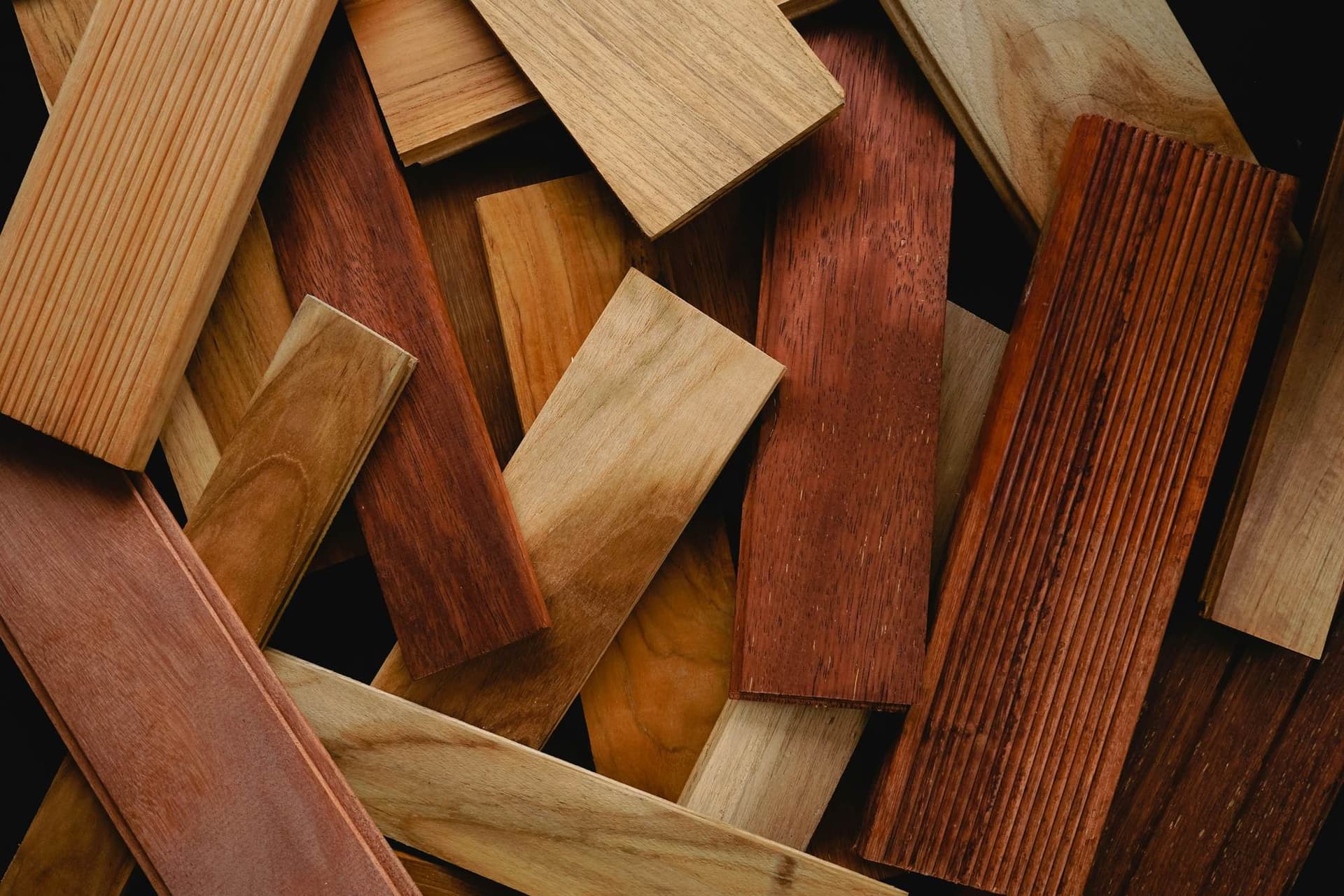
Yes, you can put real hardwood floors in a Florida house, as long as three things line up. The product has to be approved for the floor it is going over, and, if the house is on a concrete slab, the slab has to be properly prepared and dry enough for that product. The air inside the house also has to stay in the humidity range the maker sets. The National Wood Flooring Association (NWFA) says both solid and engineered wood can be installed over concrete that is properly prepared, so solid hardwood is not ruled out.
We are Mr. Wright Flooring, a family-owned flooring company in Jacksonville, and this article is part of our guide to choosing flooring for a Florida home. Below we cover how solid and engineered boards are built, what NWFA and Mohawk each say about concrete, and why moisture content, acclimation and humidity control decide how a wood floor behaves once it is down.
How solid and engineered hardwood are built
Solid hardwood is one piece of wood from top to bottom. Engineered hardwood is real wood too. In NWFA's words, instead of a solid piece of wood from top to bottom, it is made using several layers of wood veneers or lumber core that are bonded together using adhesives.
Mohawk says its engineered hardwood is engineered to be dimensionally stable, which means the boards are made to hold their size and shape. Mohawk says that makes it suitable for installation on all grade levels where excessive moisture conditions do not exist. You can see both kinds of floor on our hardwood flooring and engineered hardwood flooring pages.
Grade level matters if your house sits on a concrete slab. NWFA's installation guidelines say engineered wood can be installed above-grade, on-grade and below-grade. Solid wood can go on-grade and above-grade, but NWFA says it should not go below-grade unless the flooring manufacturer recommends it.
Can solid hardwood go over a concrete slab?
You may have heard that solid hardwood can never go over concrete. The trade association does not say that. NWFA's 2019 fact sheet on concrete subfloors says solid and engineered wood floors can be installed over concrete subfloors when the concrete is properly prepared for the wood. It also says to always follow the wood flooring and adhesive manufacturers' recommendations for preparing the slab, testing its moisture and installing the floor.
A manufacturer can set stricter rules for its own products, and Mohawk does. Mohawk is the main brand we carry (see our Mohawk selections), and its rules show how specific these limits get. Mohawk's installation FAQ says its engineered and Longstrip (glueless) hardwood floors can be installed over most concrete slabs, but not its solid hardwood. The one exception Mohawk lists is its 3/8-inch solid products, which may be glued to a slab using Mohawk's approved glue and sealant system. Mohawk also says the slab must be fully cured for at least 60 days, free of structural defects, clean, and visually dry with no history of moisture problems.
So the answer depends on the exact board. If the maker of a solid floor approves it over concrete, NWFA's guidance supports installing it on a properly prepared slab. If the maker does not, as with Mohawk's solid hardwood outside its 3/8-inch products, that floor should not go on your slab.
What the slab has to pass
Each manufacturer sets its own moisture limit for the slab, and the limits can differ even between one maker's product lines. Mohawk's TecWood Enhanced engineered hardwood instructions, for example, call for a calcium chloride test result of 5 pounds per 1,000 square feet per 24 hours or less (ASTM F1869), or less than 80% relative humidity with an in-situ probe (ASTM F2170). Those instructions say moisture tests must be done on all concrete subfloors, regardless of grade level or age, unless Mohawk's moisture-control installation method is used.
Mohawk's TecWood instructions also say not to install the floor if test results exceed the limits, and to either wait until the slab dries to meet them or use an appropriate moisture barrier. Before any wood goes down, the installer has to confirm the slab meets the limit for the product being installed.
Key takeaway: Whether solid hardwood can go on your slab depends on what that product's maker allows, not on a blanket rule, and the slab has to pass that maker's moisture limit first.
Why moisture content matters in a damp climate
Wood takes in and gives off moisture. The USDA Forest Products Laboratory's Wood Handbook calls wood hygroscopic, which means it takes on moisture from the surrounding air. The point where wood is neither gaining nor losing moisture is called its equilibrium moisture content.
The handbook's table shows how closely that point follows humidity. At 70°F, wood comes to about 6.9% moisture content at 35% relative humidity, 9.2% at 50%, 12.0% at 65% and 16.0% at 80%. As wood gains and loses moisture it swells and shrinks, and the handbook lists gaps in flooring among the problems that movement can cause.
The air outside a Jacksonville house is damp much of the time. NOAA's Jacksonville climate records show average relative humidity of 85% to 92% at 7 a.m. in every month, and 48% to 63% at 1 p.m. Those are outdoor readings. Indoors, the Wood Handbook says the moisture content of interior wood depends mainly on indoor relative humidity, which is shaped by moisture sources, ventilation, air conditioning and outdoor humidity.
The handbook also sets target moisture levels for wood flooring when it is installed. For most of the United States, the Wood Handbook's recommended average is 8%, with individual pieces from 6% to 10%. For damp, warm coastal areas, the average is 11%, with pieces from 8% to 13%. The handbook notes these values come from buildings without air conditioning; in air-conditioned homes, moisture conditions depend largely on proper sizing of the air-conditioning equipment. The handbook's advice is to install wood at the moisture content it will have in service, which keeps later swelling and shrinking small and helps avoid problems such as floor buckling.
Key takeaway: A wood floor settles at a moisture level that follows the humidity around it, so the goal is to install it at the level it will live at and then keep that level steady.
Acclimation: giving the wood time to adjust
Acclimation is the waiting period that lets the boards adjust to your home before they are installed. Mohawk's TecWood Enhanced instructions say all Mohawk wood floors must acclimate for at least 72 hours. That clock starts only after the HVAC, windows and the outer shell of the house are finished and running. Mohawk says the purpose is to let the wood's moisture content adjust to normal living conditions, meaning the temperature and humidity the home will have once people live in it.
The Wood Handbook adds a practical check: measure random pieces of flooring with a moisture meter when the material arrives and again before installation. It also warns that cracks can develop in wood flooring if the boards take up moisture before or after installation and then shrink when the building is heated.
Humidity control for hardwood floors in Florida
Once the floor is down, the air in the house is the main thing you control. The humidity targets you will see are not all the same, so go by the one that applies to your floor:
- NWFA's general rule for solid wood, with geographic exceptions, is 30% to 50% relative humidity and 60°F to 80°F. For factory-finished floors, NWFA says to follow the manufacturer's requirements.
- Mohawk's TecWood Enhanced instructions call for 35% to 55% relative humidity and 65°F to 75°F before, during and after installation, for the life of the floor.
- UF/IFAS Extension advises that indoor relative humidity in Florida homes should generally stay around 55% or lower, and suggests checking it with an inexpensive hygrometer or a thermostat with a humidity sensor.
UF/IFAS Extension points out that in Florida, air conditioners do more than cool the home, because they also remove moisture from the air. It adds that a properly sized and well-maintained HVAC system plays an important role in controlling indoor humidity. For coastal or waterfront areas and places with high humidity year-round, Mohawk's TecWood Enhanced instructions say to keep humidity in range with an air conditioner or dehumidifier.
Some movement is expected. Mohawk says all wood expands and contracts until it reaches moisture equilibrium, and that movement is smallest when indoor humidity is kept steady year-round. Mohawk also states that seasonal gapping is not a manufacturing defect, and that its warranties do not cover damage caused by excessively low or high humidity. Our article on flooring that holds up to Florida humidity compares how other floor types respond.
Key takeaway: Keep indoor humidity steady and inside the range your floor's maker sets, and keep the air conditioning running, since Mohawk's wood warranties call for a continuously climate-controlled home.
Solid or engineered: which fits your house?
If your home sits on a slab and you want the most options, engineered hardwood gives you more room to work with. NWFA allows it at every grade level, and Mohawk approves its engineered floors over most concrete slabs. Solid hardwood can still work over properly prepared concrete when the maker of that product approves it. If you are also weighing vinyl plank, our comparison of engineered hardwood and LVP for Florida homes walks through that choice.
Mr. Wright Flooring is family owned and operated in Northeast Florida since 2012. Every project is supervised by an experienced team leader who keeps the install inside the manufacturer's warranty guidelines. If you are deciding between solid and engineered hardwood, request a free estimate with an in-home measure, or call (904) 443-9473 to set an appointment to browse the selections in our showroom.
Frequently asked questions
Can solid hardwood go over a concrete slab in Florida?
It can, with conditions. NWFA says solid and engineered wood floors can be installed over concrete subfloors when the concrete is properly prepared for the wood, and its guidelines allow solid wood on-grade. The maker of the floor still sets the rules for its product. Mohawk, for example, does not approve its solid hardwood over concrete slabs, except its 3/8-inch solid products glued down with Mohawk's approved glue and sealant system.
Is engineered hardwood real wood?
Yes. NWFA describes engineered wood flooring as real wood flooring. Instead of one solid piece of wood from top to bottom, it is made from several layers of wood veneers or lumber core bonded together with adhesives. Mohawk says its engineered hardwood is engineered to be dimensionally stable, and NWFA's guidelines allow engineered wood above, on and below grade.
How long does hardwood need to acclimate before installation?
Mohawk's TecWood Enhanced instructions say all Mohawk wood floors must acclimate for at least 72 hours before installation, starting after the HVAC, windows and building envelope are complete and running. That rule is Mohawk's, so check the instructions for the exact floor you buy. The USDA Wood Handbook also recommends checking random boards with a moisture meter when they arrive and again before they go down.
What humidity should I keep my house at for hardwood floors?
There is no single number. NWFA's general rule for solid wood is 30% to 50% relative humidity, with geographic exceptions, and for factory-finished floors it says to follow the manufacturer. Mohawk's TecWood Enhanced instructions call for 35% to 55% for the life of the floor. UF/IFAS Extension advises Florida homes to stay around 55% or lower in general. Go by the range for your product.
Why do hardwood floors get gaps between the boards?
Wood shrinks as it loses moisture and swells as it gains it. The USDA Wood Handbook lists gaps in flooring among the problems this shrinking and swelling can cause. Mohawk describes the separation between planks that comes from natural expansion and contraction as something its warranties do not cover, and says seasonal gapping is not a manufacturing defect. Mohawk adds that movement is smallest when indoor humidity stays steady year-round.
Should I turn off the AC when I am away from my Florida house?
Mohawk's RevWood and TecWood warranties require the floor to be installed in an indoor, continuously climate-controlled home. UF/IFAS Extension says research-based recommendations suggest about 82°F when away to balance comfort and energy savings, and that a properly working system should still control indoor humidity at around 78°F. That 82°F is general energy advice, not a flooring rule, and it is above the 65°F to 75°F range in Mohawk's TecWood Enhanced instructions.
Thinking about new floors?
The same crew, still family-owned. Free in-home estimate across Jacksonville and Northeast Florida.