
Vinyl Plank Flooring Underlayment: Do You Need It?
Some rigid vinyl planks have a pad attached. Here is what Mohawk's SolidTech and PureTech instructions say about underlayment, vapor barriers and the subfloor.
Mr. Wright Flooring · Nov 18, 2026

Whether vinyl plank needs an underlayment depends on the product, and some rigid vinyl planks come with one attached. Mohawk's SolidTech planks carry their own foam underlayment, and for floating installs over concrete, Mohawk's instructions highly recommend a 6-mil polyethylene vapor barrier underneath.
Mr. Wright Flooring is a family-owned flooring company in Jacksonville and an authorized Mohawk retailer. We carry Mohawk SolidTech rigid vinyl and PureTech, Mohawk's PVC-free resilient floor, so this guide follows their installation instructions. It is part of our flooring installation and care guide. For any other product, check its own instructions, because underlayment rules change from line to line.
What comes attached to a rigid vinyl plank
Mohawk's SolidTech instructions tell installers that after scoring and snapping a plank, they will need to cut the foam underlayment, which comes attached to the plank. Pergo's FAQ says its Pergo Extreme rigid vinyl is built with an attached pad for stability and a natural sound underfoot.
What the SolidTech instructions do not say is whether a second, separate pad may go under that foam. Because the instructions are silent on it, ask before adding one.
Key takeaway
Check whether your vinyl plank already has a pad before you buy underlayment, and ask before adding a second layer under SolidTech.
Do you need a vapor barrier under vinyl plank?
For SolidTech floating installs over concrete, Mohawk recommends one strongly. Its instructions for concrete subfloors highly recommend a polyethylene vapor barrier of at least 6 mil, with a density of 0.92 pounds per cubic foot, for all floating installations. The barrier should overlap 8 inches and be taped at the seams.

Mohawk is clear about the limits of that sheet. Its instructions say the vapor barrier should not be used to solve moisture problems, which must be fixed by other means, and that claims for cupping or peaking without a proper vapor barrier could be denied. They also say on- or below-grade slabs must have an effective vapor retarder directly under the slab.
The slab itself has to pass a moisture test. Mohawk's SolidTech instructions allow 8 pounds or less per 1,000 square feet per 24 hours on a calcium chloride test (ASTM F1869), or less than 90% relative humidity with in-slab probes (ASTM F2170), before, during and after installation. They call for one test for areas up to 1,000 square feet and one more for each additional 1,000, with results recorded and kept, and a slab pH between 5.0 and 9.0. Mohawk puts the final call on whether the concrete is dry enough with the floor covering installer. The full requirements are in Mohawk's SolidTech installation instructions.
Key takeaway
On SolidTech over concrete, the vapor barrier is highly recommended for floating installs, but it does not fix a damp slab, and the slab still has to meet Mohawk's moisture limit.
SolidTech plank
Mohawk SolidTech rigid vinyl, floating installation.
Attached foam underlayment
Comes attached to the plank; the instructions do not say whether a second pad may go under it.
Vapor barrier
Polyethylene, at least 6 mil, highly recommended for floating installs; overlapped 8 inches and taped at seams.
Concrete slab
Calcium chloride: 8 lb/1,000 sq ft/24 hr or less. In-slab probes: under 90% RH. pH 5.0–9.0.
Vapor retarder (on- or below-grade slabs)
On- or below-grade slabs must have an effective vapor retarder directly under the slab.
Source: Mohawk SolidTech installation instructions. Mohawk says the vapor barrier should not be used to solve moisture problems.
PureTech follows the laminate table
Mohawk's PureTech resilient flooring has its own instructions, and its underlayment table matches the one in Pergo's and Mohawk's laminate instructions. Planks with attached underlayment need a vapor barrier over concrete and nothing more over wood. Planks without attached underlayment need underlayment over wood, and underlayment plus a vapor barrier over concrete. For attached-underlayment planks over concrete, Mohawk says to put down a polyethylene vapor barrier or MoistureBarrier first, with seams overlapped 8 inches or more. Our laminate flooring underlayment guide explains the same table in more detail.
An underlayment won't fix the subfloor
Mohawk's SolidTech instructions say an underlayment can help give a smooth surface, but it will not correct subfloor defects such as deflection, meaning flex, or unevenness. Structural work on the subfloor may be needed before installation starts.
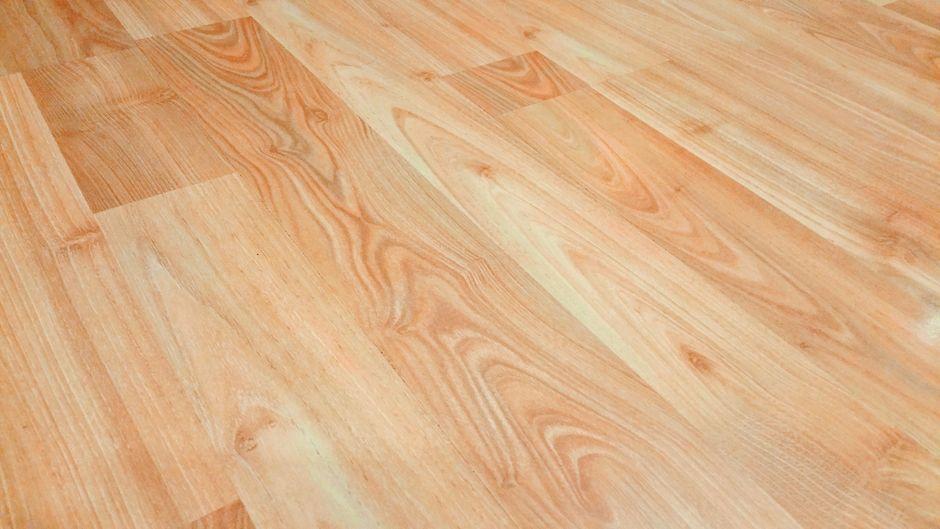
On concrete, SolidTech calls for a floor that is flat within 3/16 inch over 10 feet and 1/8 inch over 6 feet, under ASTM F710. Holes and cracks are filled with a latex-fortified portland cement patch, and Mohawk says never to use liquid adhesive removers or solvent cleaners on the slab, because they cause later failures in the new floor.
Wood subfloors have rules of their own. Mohawk says moisture readings should never exceed 14% for plywood, OSB, particle board, chipboard or solid hardwood subfloors. A wood subfloor needs 18 inches of ventilated air space beneath it, and the crawl space should be protected with a 6-mil polyethylene vapor barrier. If a wood panel underlayment is added, Mohawk recommends one designed for use under resilient flooring that carries a written warranty from its maker. APA-rated Sturd-I-Floor panels are designed for carpet only, so SolidTech over them needs at least a 1/4-inch underlayment on top.
Key takeaway
Fix flex and unevenness in the subfloor first, because Mohawk says an underlayment will not correct them, and fix moisture by other means, because Mohawk says a vapor barrier will not.
Underlayment
Can help give a smooth surface, but will not correct deflection (flex) or unevenness.
Vapor barrier
Should not be used to solve moisture problems; those must be fixed by other means.
Concrete flatness
Within 3/16 inch over 10 feet and 1/8 inch over 6 feet, under ASTM F710.
Wood subfloor moisture
Readings should never exceed 14% for plywood, OSB, particle board, chipboard or solid hardwood.
Source: Mohawk SolidTech installation instructions.
Installing vinyl plank over an existing floor
SolidTech does not always need the old floor removed. Mohawk says it can go directly over most existing floor coverings, but not carpet (including needle felt), floating laminate, other floating floor systems, luan or cushioned vinyl. It can go over well-bonded ceramic with a skim coat, PVC, well-bonded VCT (on- and above-grade), well-bonded terrazzo, glued laminate, glued hardwood and fixed wooden boards, provided they are installed over a wooden subfloor.
Existing resilient flooring used as a base has to be a single layer, not cushion-backed, fully adhered and smooth, with no signs of moisture or alkalinity. Mohawk adds that installations over existing resilient flooring may be more prone to indentation.
Getting vinyl plank underlayment right
Every project we install is supervised by an experienced team leader who keeps the install inside the manufacturer's warranty guidelines. You can buy luxury vinyl plank flooring from us and have our crew install it, have us install vinyl you bought elsewhere, or buy it from us and install it yourself or hire your own crew. Browse the Mohawk lines we carry, and once your floor is in, see how to clean LVP floors.
If you would like help planning your rooms, request a free estimate and we will measure your home at no charge.
Frequently asked questions
Do you need underlayment for vinyl plank flooring?
It depends on the product. Some rigid vinyl planks have a pad built in: Mohawk's SolidTech planks carry a foam underlayment, and Pergo says its Pergo Extreme rigid vinyl has an attached pad. Mohawk's PureTech, a PVC-free resilient floor, uses a table instead: planks with attached underlayment need a vapor barrier over concrete and nothing more over wood; planks without it need underlayment over wood, and underlayment plus a vapor barrier over concrete. Check the instructions for your exact plank.
Can I put extra underlayment under vinyl plank that has a pad attached?
Mohawk's SolidTech instructions do not say whether a separate pad may go under the attached foam, so they neither allow nor forbid it. Because of that, ask before adding one. Mohawk does highly recommend a 6-mil polyethylene vapor barrier for floating SolidTech installations over concrete, overlapped 8 inches and taped at the seams.
Do I need a vapor barrier under vinyl plank on concrete?
For Mohawk SolidTech, a polyethylene vapor barrier of at least 6 mil is highly recommended for all floating installations, and Mohawk says cupping or peaking claims without a proper barrier could be denied. The barrier does not fix moisture problems, though. The slab still has to test at 8 pounds or less per 1,000 square feet per 24 hours on a calcium chloride test, or under 90% relative humidity with in-slab probes.
Will underlayment fix an uneven subfloor under LVP?
No. Mohawk's SolidTech instructions say an underlayment can help give a smooth surface but will not correct subfloor defects such as deflection or unevenness, and structural work may be needed first. On concrete, Mohawk calls for flatness within 3/16 inch over 10 feet and 1/8 inch over 6 feet, with holes and cracks filled with a latex-fortified portland cement patch.
Can vinyl plank go over tile or old vinyl?
Mohawk says SolidTech can go over well-bonded ceramic with a skim coat, PVC, well-bonded VCT (on- and above-grade), well-bonded terrazzo, glued laminate, glued hardwood and fixed wooden boards, provided they are installed over a wooden subfloor. Old resilient flooring has to be a single layer, not cushion-backed, fully adhered and smooth, with no signs of moisture or alkalinity, and Mohawk notes the new floor may be more prone to indentation.
Can vinyl plank go over carpet?
Not SolidTech. Mohawk's SolidTech instructions exclude carpet, including needle felt, along with floating laminate, other floating floor systems, luan and cushioned vinyl, so carpet would need to come out first. Pergo's laminate instructions likewise say to remove carpet and padding before installing.
Thinking about new floors?
The same crew, still family-owned. Free in-home estimate across Jacksonville and Northeast Florida.